CheddarCat Hellcaster – Academic
Design Lead & Level Designer
(Sep 2025 – Jan 2026)
As part of the academic VFX and Game Production Studio module, lecturers created a simulated studio called CheddarCat, combining VFX, Game Design, and Game Development students. 10 total teams were formed within the wider studio and worked with industry-style workflows and tools such as Jira and GitHub, following agile scrum with weekly stand-ups.
Production ran across 10 one-week-long sprints. I was on the Hellcaster team of 12, serving as Design Lead & Level Designer on a Unity-based rhythm deck-builder.
Our team was 1 of 3 (out of 10) selected to showcase the project at EGX, MCM Comic Con during sprint 9.
Academic Context and Assessed Focus:
- Work in a simulated studio environment with industry workflows/tools
- Collaborate across disciplines (design/dev/VFX)
- Use agile scrum methods (stand-ups, sprint planning)
- Evidence contribution and reflection (exit interview and git/Jira tracking)
My Main Impacts on Hellcaster:
- Supported design direction and task focus across weekly sprints
- Designed all 8 playable levels in the final build ( + 4 additional WIP levels)
- Built level transitions and level flow using team-created gameplay systems
- Created enemies/encounters using team-built gameplay systems
- Contributed QA/playtesting and performance optimisation
Gameplay Trailer
A short overview of the gameplay, tone, and core loop.
Roles and Responsibilities
Design Lead
I supported design direction throughout development, helping keep the team aligned on goals and maintaining momentum through weekly sprints.
- Kept design goals focused through discussion, iteration, and scope management
- Maintained awareness of team tasks and dependencies to help prioritise and progress work
- Supported sprint focus and helped with delegation where needed
- Supported mechanic iteration through feedback, documentation, and flowcharts
- Produced initial boss flow planning and then supported further development
Level Designer
My main output was level design and implementation, taking levels from blockout to playable, readable, and optimised spaces.
- Designed and implemented 8 final-build levels (+ 4 additional WIP levels)
- Blocked out spaces, then iterated through playtesting to improve flow, difficulty, pacing, and readability
- Built and linked level transition rooms, integrating teammate teleporters and a healing pools to support progression
- Implemented and balanced encounters and challenge rooms using team-built gameplay systems
- Owned lighting passes and readability improvements across levels
- Supported performance optimisation (static setup, prop simplification / lower-poly replacements)
Design Iteration and Evidence
Selected examples showing iteration from playtesting and feedback.
Fundamental Level Design Direction Development
Early on, the game was structured around climbing a tower to reach a rooftop boss. Through playtesting, it became clear that the controller and core mechanics felt best when moving horizontally and downward, forcing a change in the initial design direction.
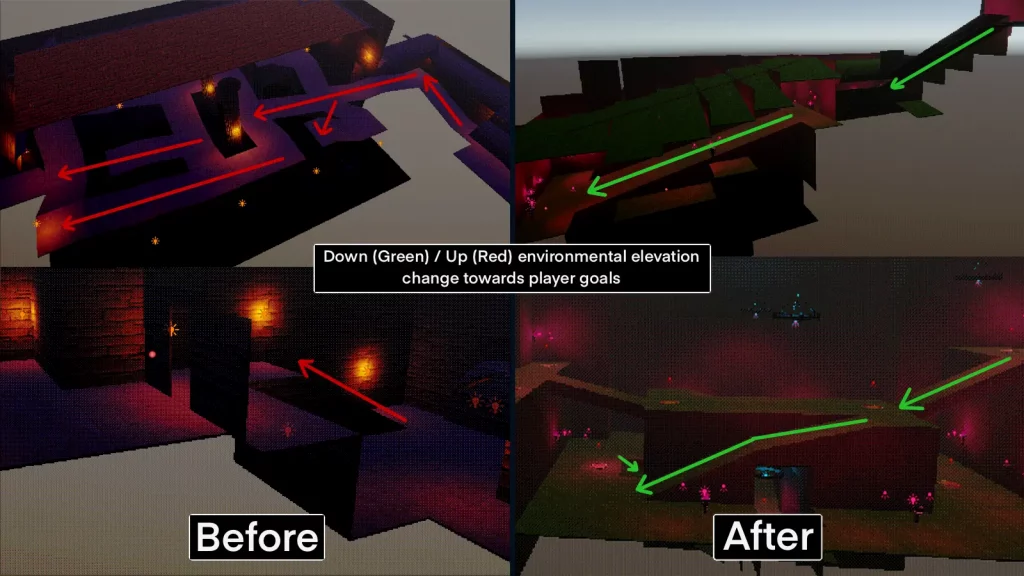
Before: Red arrows show upward progression
After: Green arrows show downward progression
- Problem: Vertical progression conflicted with the controller/mechanics
- Change: Pivoted to a downward-centric structure (start high → descend)
- Result: Clearer pacing, stronger traversal, improved readability
Readability Iteration: Tutorial Challenge Room
Selected iteration example based on feedback and observations gathered during testing and EGX showcase.
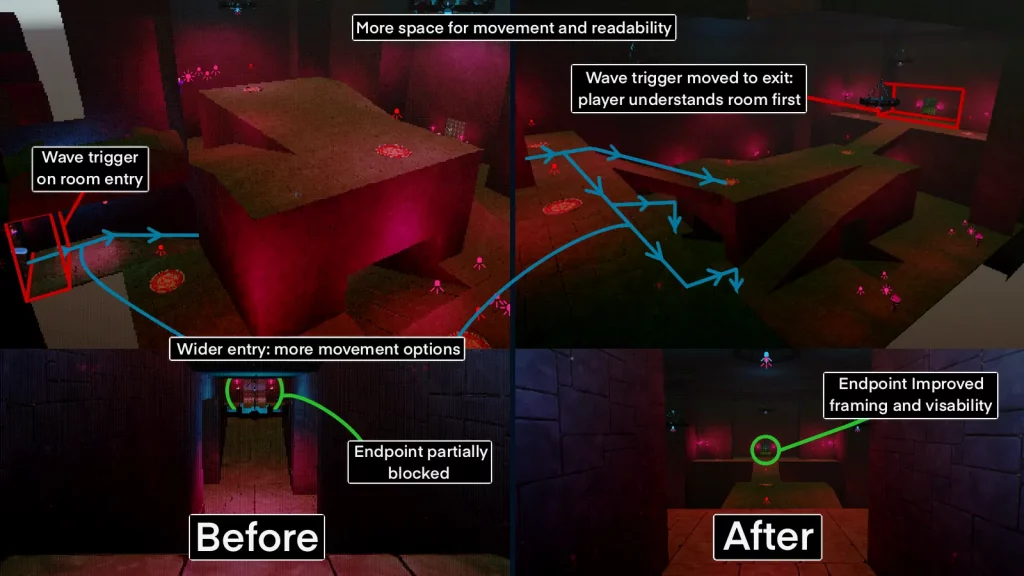
Key changes highlighted between versions
- Problem: The space was cramped, reducing clarity on the room layout and how the wave challenge worked
- Change: Expanded the room’s size and adjusted slope placement/scale to better match player expectations
- Result: Clearer understanding, more agency, and smoother challenge flow
Dark Room Clarity and Enemy Visibility
Dark rooms rely on silhouette recognition, so readability and fairness can quickly break down. These iterations focused on improving enemy separation, telegraph clarity, and player agency while keeping the low-light mood.
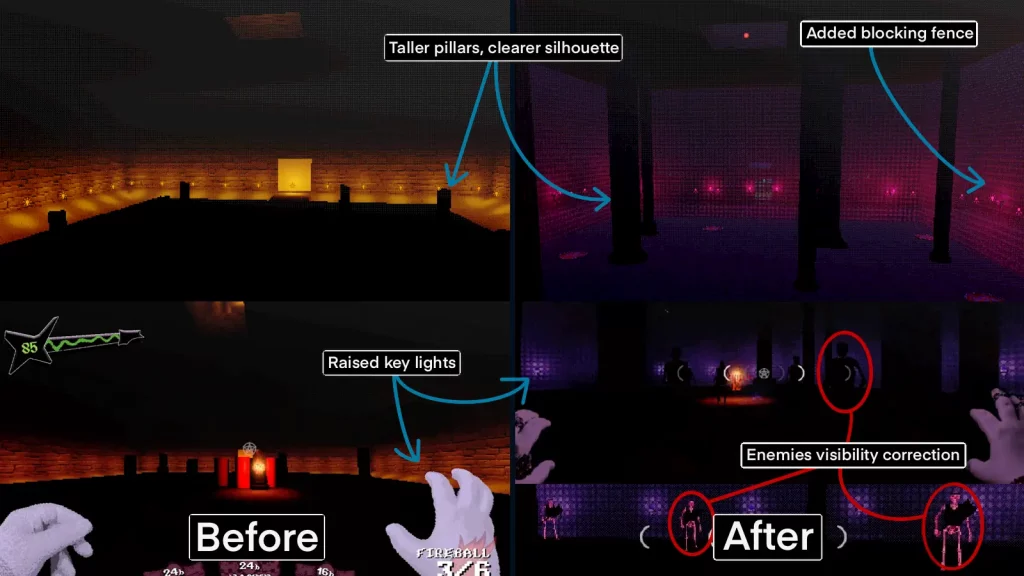
Core issues and environment readability pass
- Problem: Pillars and enemies blended together in low light, and the platform wasn’t readable during combat, causing confusion and accidental falls
- Change: Extended pillar height and raised back lighting to increase silhouette contrast. Added a blocking fence around the platform edge to improve boundary readability and prevent accidental falls/out-of-bounds behaviour
- Result: Enemies read more clearly against the environment, and players could focus on positioning and threat management without accidental edge deaths
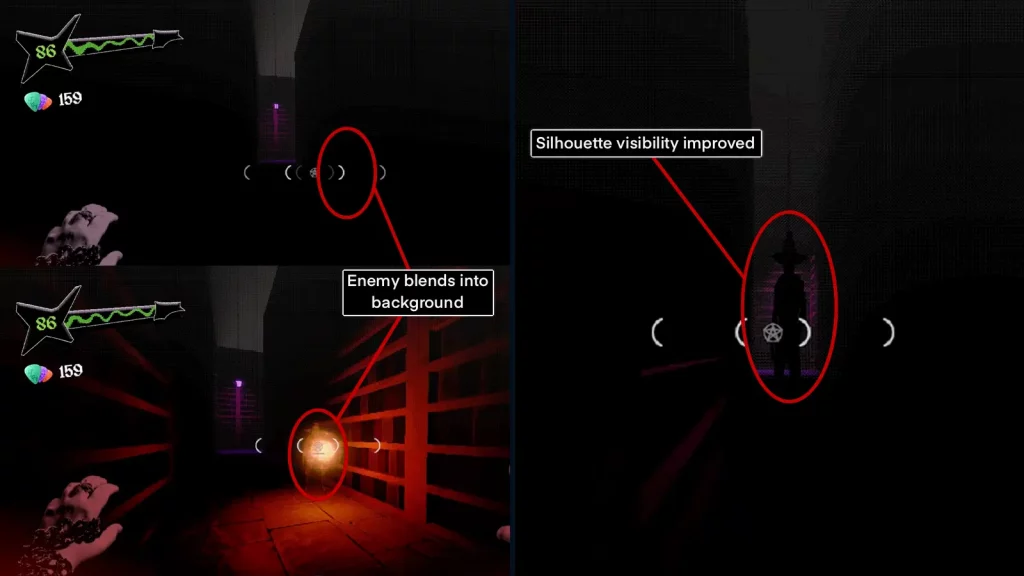
Enemy silhouette pass
- Problem: Fast enemies became hard to track at close range, reducing silhouette readability during high-tempo encounters.
- Change: Adjusted enemy silhouette proportions (longer profile) so the shape stayed readable across lighting angles and close-range movement.
- Result: Players could identify and react to threats more consistently, even during fast-paced sections.
Enemy Encounter Design
Enemy spawning triggered on room entry due to limited AI traversal (enemies immediately path toward the player). Early encounters encouraged the use of doorway choke-points and occasionally overwhelmed players when multiple enemies spawned at once.
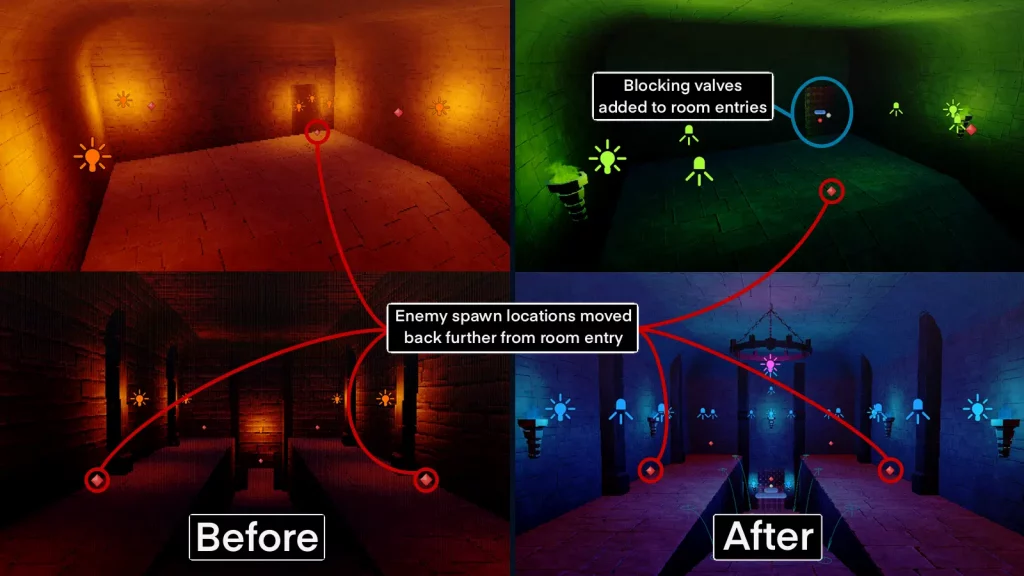
Changes to spawn placement, stagger triggers, and door valves to improve pacing
- Problem: Enemy spawn locations overwhelm players and promote uninteresting combat
- Change: staggered spawn when within larger rooms (not just on doorways), increased spawn trigger to enemy spawn distance and added the door valves to promote environmental engagement
- Result: Enemies are more manageable and less overwhelming, and players need to correctly interact with environmental elements to succeed in combat encounters properly.
Lighting Refactoring
This refactor focused on improving visual clarity across different player setups and environmental lighting conditions, while keeping the intended atmosphere.
Why the refactor was needed
- Feedback: Visibility varied drastically during testing, from “acceptable” to “barely visible”, depending on the setup
- Playtests: Players missed enemies, pits and environmental tools when only slightly outside key light areas
- Consistency: Lighting didn’t scale well across room sizes and looked unpolished when single-point lighting was applied to spaces that didn’t fully support it
What changed
The lighting approach was standardised across the project, including light spread, wall distance, placement rules, light types, intensity, and colour balance.
Professional practice update
To validate readability, I introduced a repeatable testing process using multiple monitors and contrasting real-world conditions: direct light, direct sunlight, bounced light, and no light. I also applied consistent lighting layouts for common room features (e.g., corners, walls, slopes, and drops) to ensure predictable results across environments.
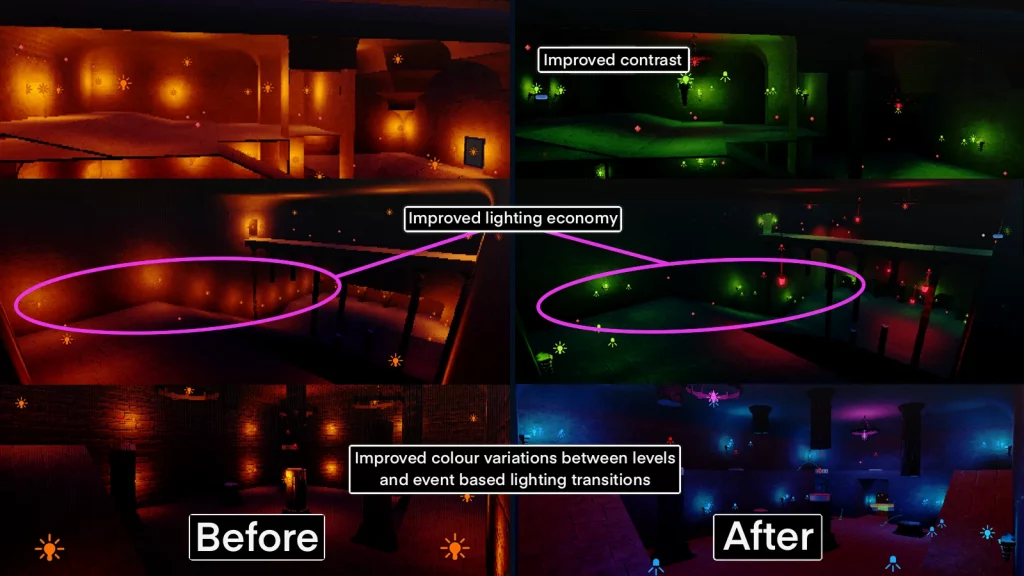
Wide and close-range examples showing improved readability across different room scales.
- Problem: Lighting lacked consistency, scalability, and clarity across different player setups
- Change: Rebuilt lighting using a consistent rule set and improved multi-condition testing
- Result: Improved readability and visual clarity while preserving tone
Performance Optimisation Pass
The optimisation pass focused on improving performance across all levels for a broader range of player hardware.
Why was the optimisation needed
- Feedback: Some levels struggled on a lower-spec machine, revealing performance issues
- Testing gap: Earlier playtests were primarily on higher-end systems, where problems weren’t noticeable
- Impact: Frame drops and stutter reduced gameplay clarity and responsiveness
What changed
General optimisation improvements were applied across levels, scene setup and occlusion/culling. A targeted pass was then completed on the library level, the primary performance issue indicator, reducing asset complexity and improving level setup to stabilise performance.
Professional practice update
This feedback highlighted bias in my testing environment. I updated my workflow to include early optimisation by default, prioritising debug statistics over how the game “feels” on my own PC, and validating performance on lower-spec machines.
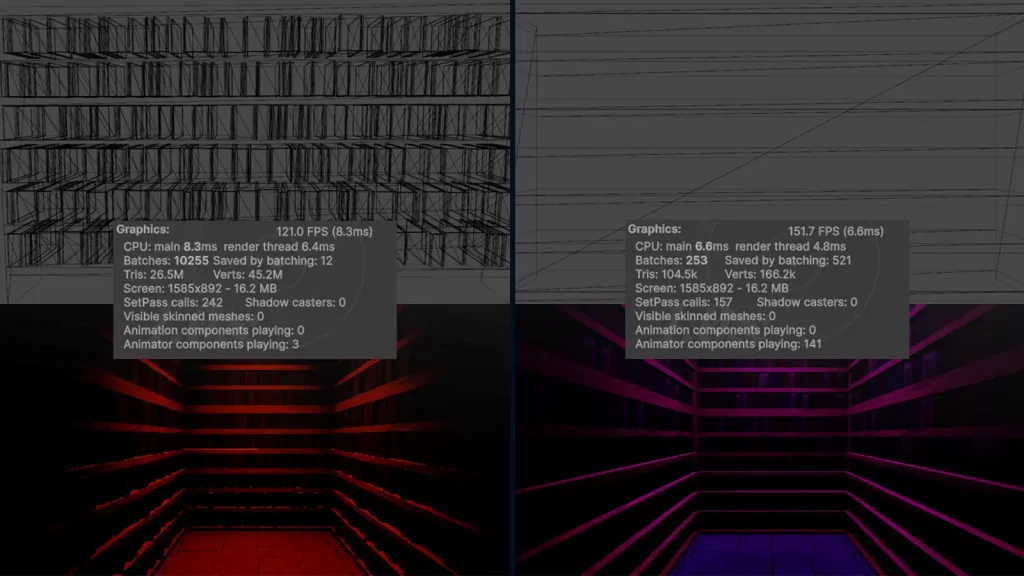
Debug statistics before/after, and changes to the primary performance offenders.
- Problem: Higher-spec testing masked performance issues
- Change: Optimise by default and use debug/profiling metrics
- Result: More stable performance and a stronger optimisation workflow
Maze Flow Breakdown
This level uses a maze-like layout built around a clear linear spine, with optional branches that add variation without compromising player direction. The space uses a dark-room lighting approach with anchor lights along each stretch to support silhouette recognition and readable navigation.
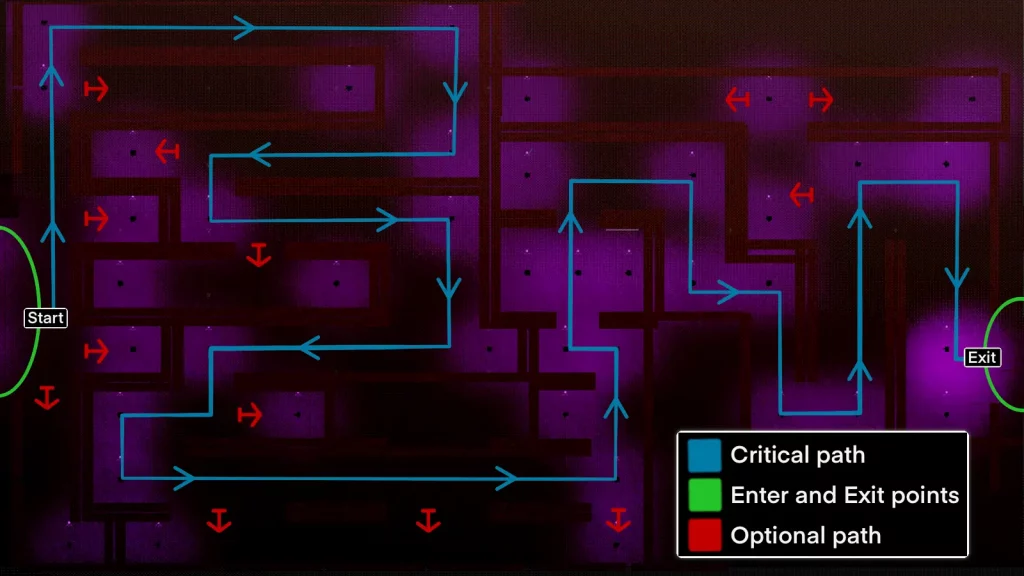
Annotated main route, optional branches, and enemy spawn zones/trigger volumes.
Design goals
- Maintain “maze” themes without losing player orientation
- Support readable combat spaces and enemy telegraphs
- Control difficulty spikes using pacing and staged spawns
How the flow works
- Linear spine: A core main route that always progresses toward the goal
- Branch pockets: Short dead-end or loop branches used for variations
- Reorientation cues: Lighting placement and bookshelf layouts that guide players back to the spine
Staggered spawns
- Spawn triggers: Enemies spawn triggers are staggered rather than immediately on entry
- Stagger timing: Spawns are spaced out to prevent instant overwhelm and allow threat prioritisation
Result: The level retains maze-style variety while staying readable, with encounters that scale smoothly and encourage movement through the space.
Iteration note
Earlier layout explorations were more maze-dense, but testing showed readability and encounter constraints worked best with a stronger main route. The final version preserves maze identity through branching pockets while keeping progression clear.
Key Takeaways
- Design leadership depends on whole-project awareness.
Supporting the team as Design Lead reinforced the importance of understanding overall project progression beyond my direct tasks, responding to feedback effectively, and keeping design direction aligned through iteration. - Industry workflows became practical through sprint delivery.
Built confidence using Jira, Git, and Unity within an agile scrum pipeline, maintaining momentum through weekly stand-ups, sprint focus, and clear task tracking. - Integrating team-built systems strengthened collaboration skills.
Implemented team mechanics, encounters, transitions, and enemy variations using team-created tools and systems, reinforcing how to communicate constraints clearly and integrate work across disciplines. - Enemy and encounter design benefits from staged pacing.
Iterating on spawn placement, stagger timing, and gating reduced overwhelm and encouraged players to engage with the space rather than rely on doorway choke-points. - Lighting consistency required both rules and repeatable testing.
Refactored lighting using a standardised approach (spread, placement, intensity, and visibility) and validated it across multiple monitors and real-world lighting conditions to improve readability without losing tone. - Metrics-led optimisation improved performance judgment.
Moved optimisation decisions toward debug statistics rather than how the game “felt” in testing, improving stability across lower-spec hardware.
Want To See More?